
Last updated: July 8, 2023
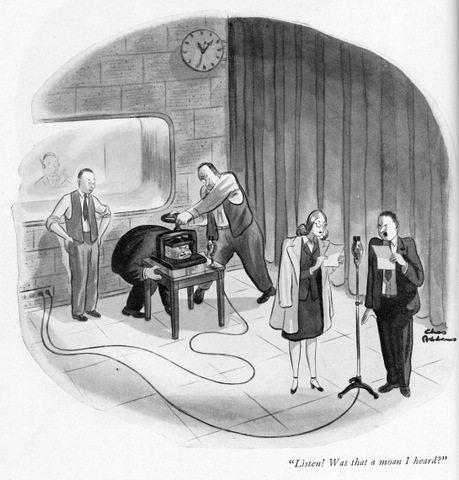
MAN: Listen! Was that a moan I heard?
I was asked how to create good horror stories as radio plays, specifically, "What scares people on radio?"
Radio--being an abstract medium, just sound--is well-suited for imaginative happenings--much like the print versions of horror or science fiction stories. Unlike film horror, in a radio play your special effects budget is unlimited. The listener's imagination is your slave/genie. You need only suggest something and the audience will conjure it up in their minds. If I describe something, say, "This morning, I saw a furry little squirrel crawling on the phone pole, up near the wires... and ZAP! He got electrocuted!", you instantly can picture the squirrel and hear--in your mind's ear--the 8,000 volt ZAP as this furry creature gets fried alive.
So the key to radio horror is the same one for all other radio genres; you must convincingly weave a world. Since the fantastical is easy to depict with sound and story, the radio play is a perfect medium for horror. So, exploit the medium. Imagine yourself sitting around the camp fire telling spooky tales--now do it on radio with music, sound effects and more voices.
I was already an experienced radio playwright when I was commissioned to write a couple of horror shows. Not knowing much about the horror craft, I did some research and found plenty of advice on creating contemporary horror novels (use everyday settings, avoid all the spooky clichés, etc.) Unfortunately, I was seeking to write classic, old-fashioned horror, so most of the current "How to" books were useless. However, for any dramatic writing, I always keep in mind Alfred Hitchcock's lessons about suspense from Hitchock/Truffaut, the wonderful book-long interview by Francois Truffaut. In it, the "master of suspense" explained how he manipulated audiences so well in his films. I find suspense more useful in horror than gore or grisly surprise and many of Hitch's techniques can be applied to radio storytelling.
There are the many books advising wanna-be Stephen Kings and some are handy. In How to Write Tales of Horror, Fantasy & Science Fiction edited by J.N. Williamson, I found Dean Koontz's essays useful. I also enjoyed H.P. Lovecraft's short 1927 analysis Supernatural Horror in Literature. Directly dealing with radio drama, Stephen King's Danse Macabre, a non-fiction essay collection on horror, includes a chapter on "Radio and the Set of Reality." These works were useful, but not essential. (Note: several of these titles are currently out of print. Try your public library or the Bookfinder website.)
Mostly, I read old horror short stories. I love M.R. James early 1900s short stories. Try "Casting the Runes: And Other Ghost Stories" or any collection of H.P. Lovecraft's short works. I actually avoided studying old-time-radio horror programs like "The Witch's Tale," "Inner Sanctum" or even Arch Obler's brilliant "Lights Out" because I wanted to approach the genre freshly. So I sat and thought, "What makes for scary scenes?" And "How do I make them work in radio?"
By exploring a generic idea of "what's scary," I was able to intuit some approaches to radio horror. If you can understand the ideal--telling a story in a scary manner, then you can apply what you discover throughout your story.
Over the last 2 million years, humans became adept at recognizing patterns, so depicting patterns of peril are useful for spooky dramatizing. Gothic novelist Anne Radcliffe contrasted horror (actually stepping on a corpse) with terror (fearing you might step on a corpse.) A classic terror cliché is the damsel walking alone through the graveyard or the damsel wandering alone into the monster's lair. Here, "something bad" is about to happen. It is usually a severe "forced lowering" of her status--being abucted, attacked, or killed. Your job as a writer is to delay the bad something as long as possible--thus creating suspense. For advice on what to have happen, see the recommended books above. The actual content of the scene is up to you, but how to convey that content is what I'm examining here.
In a print novel, the author narrates the girl's passage, describing the surroundings and her mental state. In a film, the audience can actually see the creepy surroundings and the werewolf lurking in the background.
However in radio, the audience is blind. In order for the radio listeners to "see" the surroundings and action, you can only rely on narration, sound effects, and dialogue. This is the case for all genres on radio, but horror presents special problems for radio writers because our usual approach to spinning a world into being can actually detract from the horror.
For our damsel in the graveyard scene, we need to depict where she is and what's happening. Using a typical narrator can work, but his very presence distances the listening audience from directly experiencing the terror/horror "face to face." One of Alfred Hitchcock's great strengths was to put the viewer into the place of the protagonist--the audience experiences what the imperilled character experiences--say, the shower scene in Psycho (1960). That audience-identification with the soon-to-be-victim is the core of making terror/horror work--regardless of medium. However, the use of a narrator here will cut into the listener's identification with the damsel--something that can be fatal to fright. So, one desirable element--identification with the protagonist--may be difficult to sustain at the most direct level.
Sound effects alone often aren't clear enough to work here. The sound of the damsel's footsteps amidst the wind and an occasional ghostly moan have only a limited power to frighten. Here, these clichés will work against you--they've been drained of their potency through over-use. Plus so many sound effects by themselves can be mis-read by the audience and merely confuse the action. Think of those terrible "horror sound effects" recordings they sell every Halloween. Sit down and listen to one for a while and you won't be enthralled for long. Many amateur radio-drama producers slap some horror cliche sound effects together and then wonder why the audience is scratching their heads.
Spooky music can help, but by its abstract nature, music can't render concrete details about graves or tentacles in the shadows reaching out to grab the damsel. Use music, but don't rely on it to carry the story. To render those details, we need voices.
Normally, in radio, when you need to describe a scene or some action, you add a second character and have the two exclaim to each other what they (and thus the audience) are seeing. "Look, Phyllis. It's a g-g-ghoul!" This can work, but there's a drawback. If there are TWO damsels walking through the graveyard together, it's not as threatening as it was when there was only one--alone. This extra damsel is different than the narrator--she can be killed, but once she's dead, you're stuck again with trying to depict a scene with one character, the original damsel.
I might get around this by having the damsel talk to herself as she progresses through the scene. Maybe you can throw in some rationale for conversation (giving her a mouse or memory of a friend) and have her talk to it and ask it questions. Maybe you can do a montage of "voices from the past" warning her, "Whatever you do, don't go into the basement!" You'll have to see what works.
As an exercise, go ahead and write this scene, record it quickly and play it back. Then re-write, record and play that back. Repeat this process until you discover what works. I often cook up a few horror set-pieces and then build out the rest of the story from there.
Typically, books on writing for film and print advise you to "Show, don't tell"--depict everything in real time (or flashback). However, in radio-drama, a very effective way to render terror/horror is to have a character TELL a spooky story within the main story and accompany it with music, sounds, and occasional dialogue. This narration-with-accompaniment was the great Norman Corwin's most powerful technique--although Norman (a mentor of mine) didn't write traditional horror stories for radio.
In "Buried Treasure-Hunters!," an episode of my Grim Scary Tales horror anthology series, I had an idea for a scene where corrupt crusaders are venturing through an underground city in 1204 A.D. Turkey. They wade through an "ocean of bones" to find a golden tomb and as they open it, are attacked by Ifrits (snake haired monsters from the 1001 Arabian Nights). I first envisioned it as a real-time scene, but that took a lot of time on radio: "Look! Up ahead! What's that?" "It's a tomb." "A golden tomb!" "Gold!" "I knew it!" "Let's go in!" "Should we?" etc.
Since ghost stories tend to work best when told around a fire, I instead rewrote the scene as a tale told by a frightened survivor of the attack. Sir Harald narrates the adventure with spooky supporting music, one line of "live" dialogue and some key sound effects--wading through the ocean of bones, frightened walla walla, prying open the tomb, attacking creatures, swords, etc.
1. MUSIC: CAVERN TOMB--[BED]--CONTINUE UNDER.
2. SIR
HARALD: (NARRATING) ...Deeper we went, past hellish
lava pits,
the remains of ancient camps--ghastly and strange! But
in a large grotto, lit by some far off dim glow, a
foul stench arose! The smell of a thousand open graves!
(PAUSE) Some wished to turn back, but Cliff of Thorsness
refused! Up ahead, Sir Garrick yelled...
3. SIR GARRICK: [REVERB] Lord Cliff! Look! Ahead! An ocean of...
4. SIR
HARALD: (NARRATING) ...Bones!--a vast sea of
bones--skeletons,
strewn hither and yon! In the center of this grisly pool...
we spied an... ancient tomb! The treasure of the Saracens,
we thought, but this tomb was not Muslim. It looked much
older--not made by man!
5. SOUND: WADING THROUGH BONES. WALLA--FRIGHTENED MEN.
6. SIR
HARALD: (NARRATING) We waded through the sea of bones
to reach
the tomb.... when suddenly...
Above is a condensed script-excerpt of Sir Harald's Tale (MP3) from Grim Scary Tales - "Buried Treasure-Hunters!" Listen to the full scene to hear how narration-with-accompaniment works its magic in radio-drama.
Here, the storyteller moves things along and keeps the action clear--which is essential for radio action scenes, but also to control the tale. This narration-with-accompaniment approach made a much better scene than a full-dialogue version. It really played to radio's strengths--using narration, evocative music, and sound effects. Employing a character as narrator (as opposed to the standard omniscient narrator) you can inject fear into the telling.
Contrary to what I'd said earlier about how desirable it is to put the listener into the character's shoes to experience the horror directly, here I used a narrator to actually distance the listeners from that identification--but I had a reason. By deliberately removing the listeners from a direct experience of the horror scene, I could fuzz up their perception and keep things a bit murky or unknown. Later, I could put the damsel into the same location and the audience might expect a repeat of the pattern of peril. So, normally, clarity is what you strive for in radio drama, but horror is one area where less is often enough. Try to avoid fully describing a monster--just give snatches of it. Let the audience's imagination paint their own bug-eyed demons.
With Sir Harald's ghost story told, now the listeners had knowledge of a potential toppling awaiting, so I could later put my heroine into the caverns and anything she did there frightened the audience. The suspense about some potential toppling created a sense of dread. And that suspense makes terror work. Try to delay direct confrontation with the monster until the climax of the story, since once you get to the "Boogie Man" you'll have to resolve the story--either the damsel escapes or the monster eats her.
Another audio example of narration-with-accompaniment is the quite spooky "Horseman's Origin" from my The Headless Horseman of Sleepy Hollow plplay. This scene takes place early-on in the story, marshalling music, sound and voices to depict the first of the "monster encounters" that make for audience-satisfying terror/horror.
There is a major difference between adventure stories and horror stories. In an adventure, the heroine would escape the terrible evils. In a horror story, she doesn't escape. I don't like pessimistic endings and so, find horror less creatively fulfilling. But that's my own taste. I can only enjoy having taken the listeners on a roller coaster ride and for that, horror, suspense, and fear are well-suited.
Here's an excerpt of a production of mine that uses music, sound, two types of narration, as well as dialogue to evoke and sustain a sense of dread for a "monster encounter".
Scrooge & Marley Encounter (MP3) - from my adaptation of Charles Dickens' A Christmas Carol.
Fear of the unknown is very powerful. Since total clarity in radio is nearly impossible, it lends itself to keeping things unknown. You must seek to exploit this unknown-ness. Use radio's "smoke and mirrors" to your advantage... because where there's smoke--there's fear!
<